
Blog · Strategy · 8 min read
Social media SEO:the results everyone is ignoring
Everyone is optimizing for AI search, and rightly so. Almost nobody is optimizing the social profiles that Google and AI assistants read to decide who you are.
A confession before the argument: I do not have personal social media. I have had it, I did not like it, and I closed it. I think it is addictive by design and I would rather not carry it in my pocket. My relationship with social platforms is one hundred percent professional: I work on them for clients the way a plumber works on pipes he would not want in his own living room.
That is exactly why I feel entitled to write this. I have no emotional stake in the platforms, no follower count to protect, and no interest in telling you to post more. What I have is years of watching search results and, lately, AI answers, and noticing the same thing in both: the social profiles of most businesses are doing almost nothing for them, at precisely the moment when they could be doing a great deal.
The blind spot in the middle of page one
Right now almost everyone in my field is focused on AI search optimization: how to get cited by ChatGPT, how to appear in Google's AI Overviews, how to be the source Gemini picks. That is the right call. I have been doing it too, I wrote a chapter of my book about it, and the results on client sites have been real.
But there is something people have ignored for years, and are ignoring even harder now that the new thing has their attention. Search for almost any brand, and often for a brand plus what it does, and look at the results. Alongside the website there are social profiles: a LinkedIn page, an Instagram account, a YouTube channel, a Facebook page, sometimes a TikTok. They have been on page one for a decade. They are routinely the second, third and fourth result for a brand name. And in most businesses nobody owns them as search assets. The marketing team posts to them; nobody asks what they say to a crawler.
The AI era makes this worse, not better. A few weeks ago I searched for artichokes delivered near me, in Spanish, to check on a small site I had just built. Google's AI Overview answered, and one of its two cited sources was an Instagram post from a restaurant. Not a website, an Instagram post. The retrievers behind AI answers read social content as readily as they read web pages, and they use it to decide who is a credible answer to a question. If that is where the machines are looking, that is where the clarity has to be.
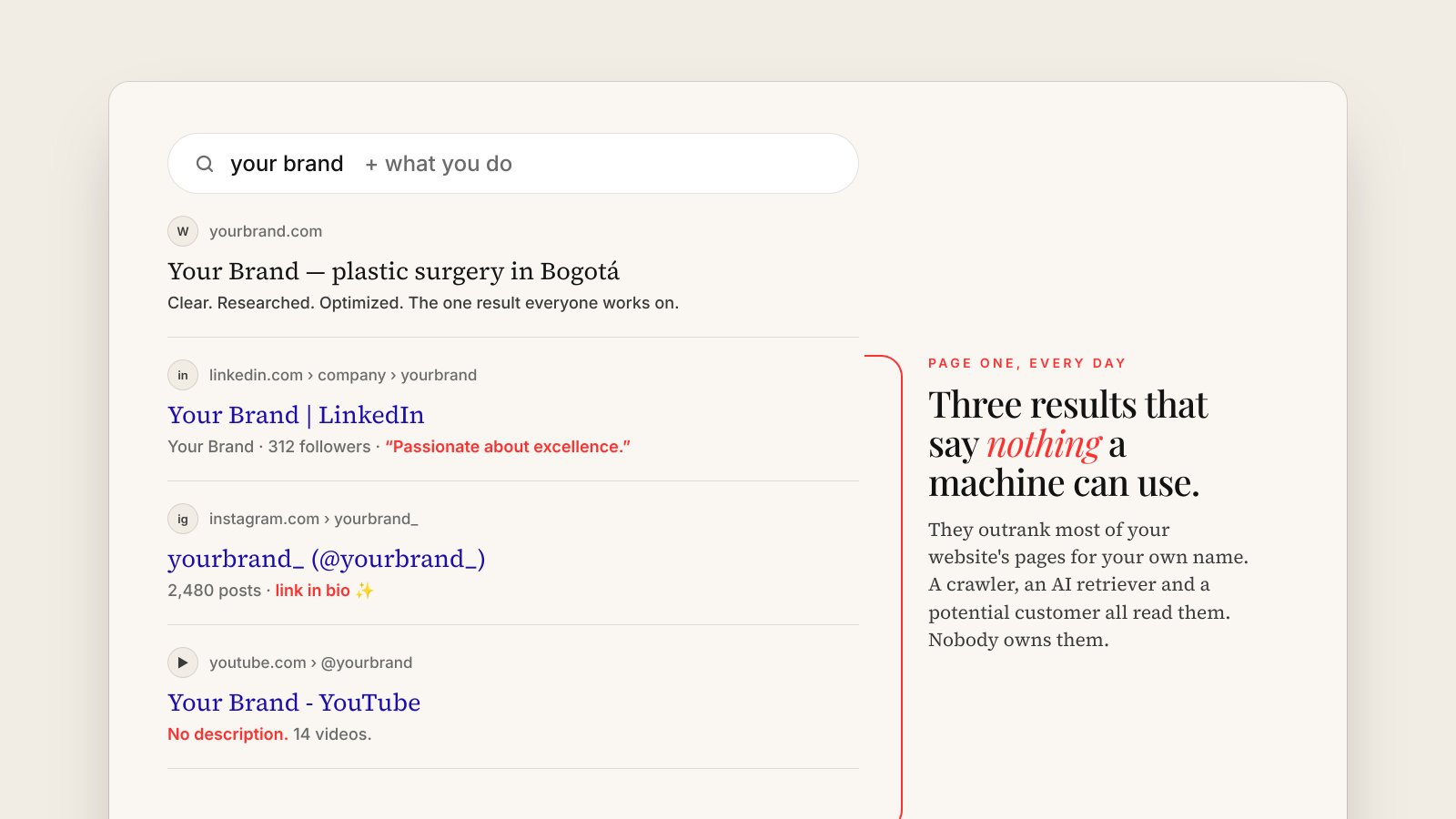
Your profiles are part of your online presence, whether you curate them or not
Here is the mental model that changed how I handle this for clients. A search engine, and increasingly an AI system, does not rank your website. It ranks an understanding of your business, assembled from everything it can find about you: your site, your Google Business Profile, your reviews, the places that mention you, and your social profiles. Off-page SEO has always been about that wider body of evidence. Social profiles are a large, highly visible, fully controllable part of it, and they are the part most brands leave half-finished.
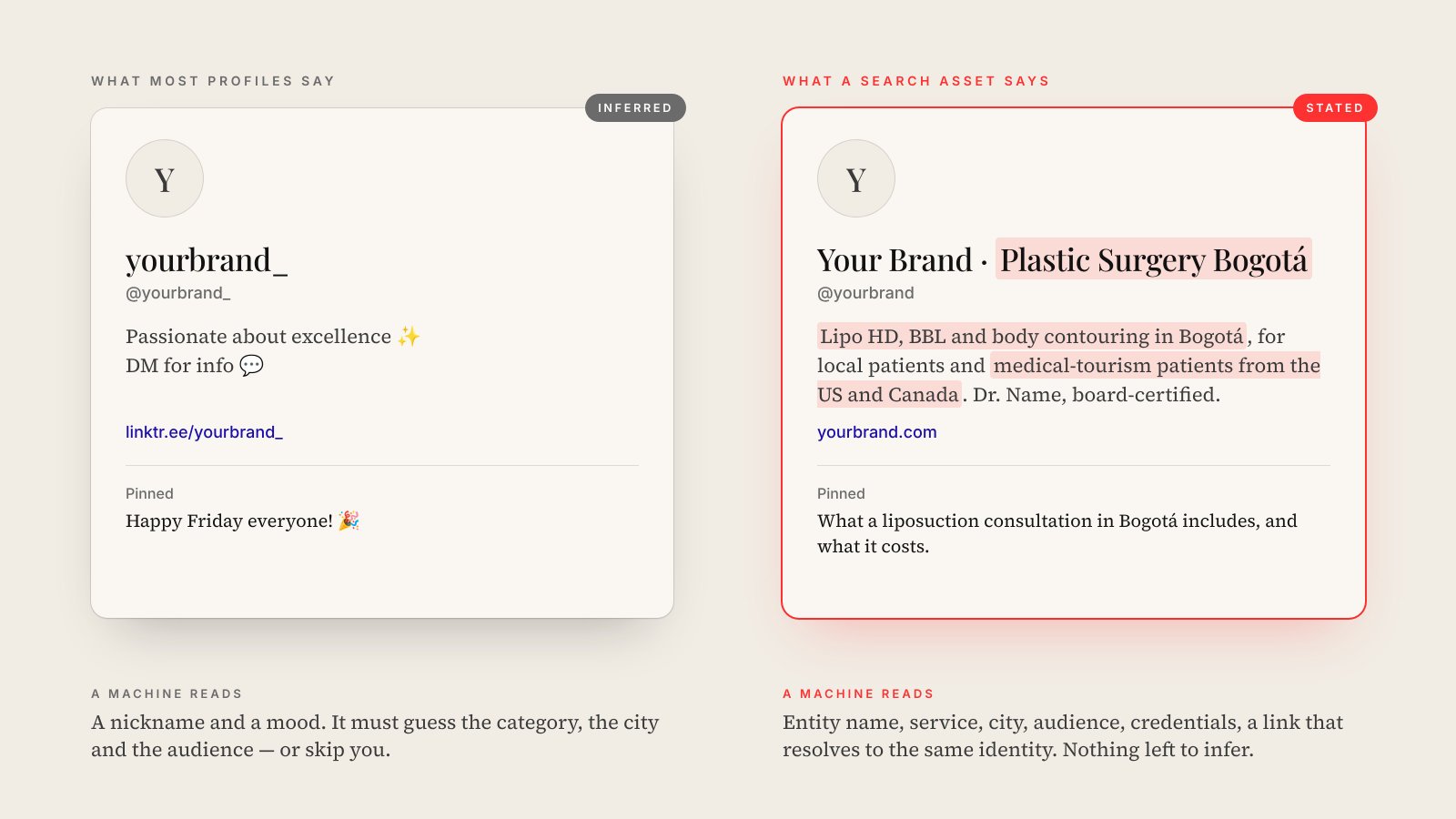
So the question is not "should we be on social media". The question is: when a crawler or a real-time retriever reads our Instagram bio, our LinkedIn page and our YouTube channel description, does it come away knowing what we do, for whom, and where? Or does it have to infer it from a handle, a slogan and a grid of photos?
I have watched this play out with my clients' brands and with my own: the search marketing brand I am about to launch. In every case the lesson was the same. Do not let Google or an AI infer who you are. Tell it. A profile whose name, bio and pinned content state the value proposition in plain words gets described correctly by AI assistants and ranks for the brand-plus-service searches that bring customers. A profile that leaves it to inference gets described vaguely, or wrongly, or not at all. Inference is where brands get lost.
What social media SEO actually involves
None of this requires you to become a content creator. It requires you to treat a handful of fields and decisions with the same seriousness you would give a title tag. I go through them in the order I fix them.
The profile name. This is the single most-read field on any social platform, by people and by machines. On most platforms the name is separate from the handle, which means you can keep the handle clean and put the clarity in the name: "Clinic Name · Plastic Surgery Bogotá", "Studio Name · Architects, Lisbon". A platform's own search leans heavily on the name field, Google reads it as the page title, and an AI retriever reads it as the entity's label. If your main keyword can live there honestly, put it there.
The bio or description. One or two sentences that say what you do, for whom, and where, in the words customers use. Not the slogan. Not "passionate about excellence". A medical clinic's bio should contain the procedures and the city; a software product's should name the category and the user. This is the same discipline as keyword research: find out how demand is phrased, then phrase yourself the same way.
Consistency across platforms. Local SEO taught everyone that name, address and phone must match across every listing. The same rule applies to social: the same brand name, the same description of what you do, the same link, on every profile. Every mismatch is a reason for a machine to be less certain that these profiles belong to the same business, and uncertainty is expensive in a ranking system. Where the platform allows it, link the profiles to the website and the website back to them. Mark them up with sameAs in your structured data so the connection is explicit rather than inferred.
The pinned and featured content. Most platforms let you pin a post or feature a section at the top of the profile. That is the one piece of content you can guarantee a visitor, and a crawler, will see first. Use it for the clearest possible statement of what you offer, with evidence: a case, a result, a before-and-after, a short explanation. It is the hero section of a page you do not fully control.
A keyword strategy for what you post. This is the part that turns a profile from a static listing into a search asset. The posts themselves are indexable: their captions, their titles, their on-screen text, their alt text. If your keyword research says customers search for "lipo HD en Bogotá" and "liposuction in Colombia", then over a quarter your posts should say those things, in those words, in context. Not every post, and never clumsily, but with intent. A profile that has talked about the same subject consistently, in the language of the people searching for it, becomes a credible candidate for that subject in the platform's search, in Google, and in the sources an AI assistant retrieves. That is exactly how a website earns a topic. The profile earns it the same way.
Measure it. Search Console will show you the brand and brand-plus-service queries your site receives; search those phrases yourself and note which social profiles appear and what their titles say. Ask ChatGPT and Gemini to describe your business and see whether what comes back matches what you would say. If it does not, the gap is usually visible in the profiles.
Why this matters for conversion, not just visibility
There is a commercial reason to care beyond rankings. When someone searches for your brand, they are usually close to a decision, and the results page is their last look before they contact you. If the website says one thing, the Instagram name says a nickname, and the LinkedIn page describes a company that pivoted two years ago, that person hesitates. Clarity across the whole results page is what makes a brand feel real. The same clarity is what lets an AI assistant recommend you with confidence instead of hedging, and a confident recommendation is the one that gets acted on.
I would go further. In a world where more and more discovery happens inside an answer rather than on a list of links, the businesses that get chosen will be the ones whose identity is unambiguous everywhere a machine looks. Your website is the primary statement. Your social profiles are the corroborating witnesses. If the witnesses are vague, the statement is weaker.
Where to start this week
Search your brand name, then your brand name plus your main service, and write down every social profile that appears and what its title and snippet say. Open each one and read the name and bio as if you knew nothing about the company. Fix the names first, then the bios, then the links, then pin something that proves the claim. Then take your keyword list and decide which three phrases your posts will deliberately own this quarter. That is a few hours of work, it costs nothing, and it is more than most of your competitors will ever do, because they are busy with the new thing.
I still will not be opening a personal account. But every business I work with gets its social profiles treated as search assets from day one, because the search engines and the AI assistants are reading them whether we curate them or not. It is better that they read a clear statement than a guess.
Frequently asked questions
What is social media SEO?
Social media SEO is the practice of curating your social media profiles and content so that search engines and AI assistants can understand who you are, what you offer and where you operate. It covers the profile name, handle, bio, link, pinned content and the language of your posts, so that these assets rank for the searches that matter to you and describe your business accurately when a machine reads them.
Do social media profiles help SEO?
Yes, in two ways. Directly, social profiles are web pages that Google indexes and often ranks on page one for brand searches and for brand-plus-service searches. Indirectly, they are part of the body of evidence search engines and AI systems use to build a picture of your business: what it is called, what it does, where it is, and whether other sources agree. A consistent, keyword-clear profile strengthens that picture; a vague or inconsistent one weakens it.
Does social media matter for AI search like ChatGPT and Google AI Overviews?
It does. AI assistants retrieve and summarise information from across the web, and social profiles and posts are part of what they retrieve. Google's AI Overviews already cite Instagram posts and other social content as sources. If your profiles clearly state what you do, an AI system has evidence to describe and recommend you accurately. If they do not, it will infer, and inference is where brands get described wrongly or left out.
Should I put keywords in my social media profile name and bio?
Yes, if you can do it naturally. The profile name and bio are the two fields every crawler and retriever reads first. A name like "Clinic Name · Plastic Surgery Bogotá" and a bio that states the service, the location and the audience in plain words give a machine exactly what it needs. Keep it honest and readable; the aim is clarity for a person and a machine at the same time, not keyword stuffing.
Is social media SEO the same as social media marketing?
No. Social media marketing is about audiences, engagement and reach inside the platform. Social media SEO is about how your profiles and content perform as search assets, on Google, on the platform's own search and inside AI answers. You can do one without the other, and many businesses with large followings still have profiles that say nothing a search engine can use.
Do I need to be active on every platform?
No. You need to be clear on the platforms that appear when someone searches for your brand or your category, and consistent across all of them. A complete, accurate profile that is updated occasionally is worth more for search than a frantic posting schedule on a profile whose name and bio never say what the business does.
About the author
Alejandro Muñoz leads SEO for a portfolio of U.S. service brands and is the author of Search Marketing: A Practical Field Guide, free to read and listen to on this site. More about Alejandro →
Keep reading — the whole book is free
Nine chapters on keyword research, competitor analysis, on-page and off-page SEO, reporting and AI search optimization. Read online, listen, or take the PDF.
Apply it to your business
Want this done for your market?
A private 60-minute strategy session with Alejandro Muñoz — research-first, no assumptions.